When planning an exterior renovation or new construction project, one of the first questions homeowners, builders, and contractors ask is:
“How much will this cost?”
It’s an important question—but one that’s often answered too simply.
While the price of the material is an obvious starting point, it represents only one portion of a project’s overall investment. Installation labor, project timelines, maintenance requirements, and long-term durability all contribute to the true cost of an exterior cladding system.
In today’s construction market, where budgets are tighter and skilled labor remains a valuable resource, the smartest decisions aren’t always based on the lowest price per square foot. They’re based on total installed value.
Understanding what drives the total cost of a project can help homeowners and construction professionals make more informed decisions and evaluate exterior cladding options beyond the initial purchase price.
Looking Beyond Price Per Square Foot
When comparing exterior cladding products, it’s easy to focus on material pricing alone. But experienced builders know that material cost is only one part of the equation.
A complete project budget should also account for:
- Material costs
- Installation labor
- Project duration
- Equipment and jobsite logistics
- Long-term maintenance
- Product durability
- Curb appeal and resale value
Together, these factors contribute to what many construction professionals consider the total installed cost of a project.
A product with a slightly higher purchase price may ultimately cost less to install if it reduces labor, shortens the project schedule, or minimizes future maintenance. Likewise, a lower-priced material can become more expensive when additional installation time, specialized labor, or ongoing upkeep are factored into the equation.
Looking beyond the material price provides a more complete picture of long-term value.
What Makes Up the Total Cost of an Exterior Cladding Project?
The material itself is only one component of an exterior project’s overall investment.
Installation labor often represents one of the largest project expenses, while scheduling, equipment, and long-term maintenance can also influence the total cost of ownership.
Rather than evaluating products solely on purchase price, many contractors consider the combined impact of every phase of the project—from installation through long-term performance.
Understanding these cost drivers helps create a more accurate comparison between exterior cladding systems and supports better decision-making for both homeowners and professionals.
Comparing Exterior Cladding Systems
Every cladding system offers a different combination of appearance, installation requirements, maintenance needs, and long-term value. While every project is unique, the comparison below highlights the characteristics that most influence total project cost.
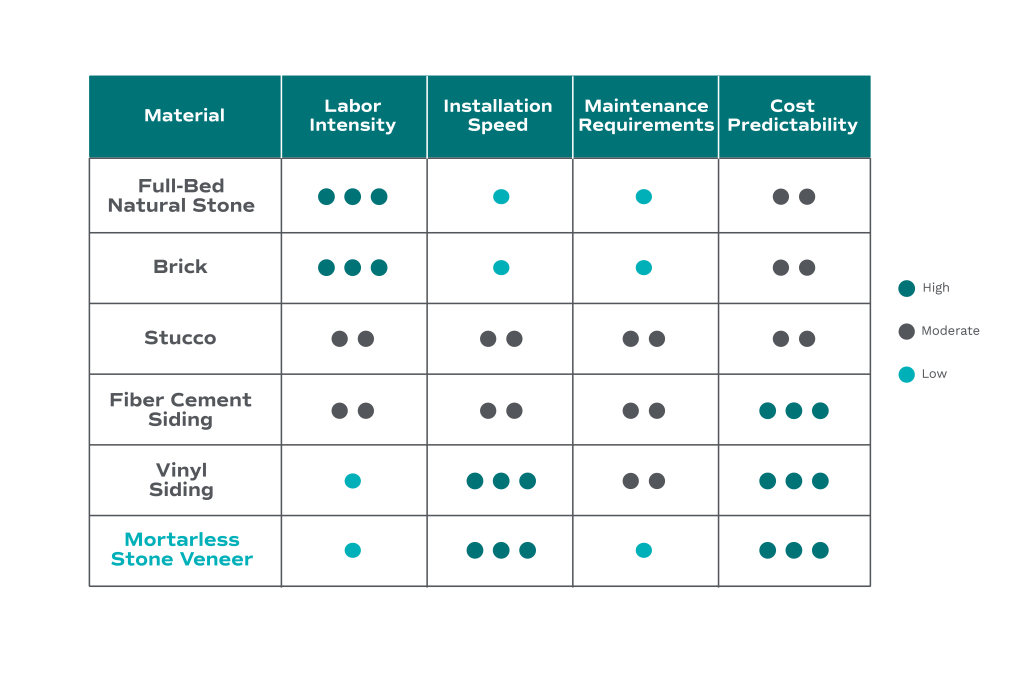
General comparison based on typical installation characteristics. Actual project requirements vary based on project scope, installer experience, geographic location, and jobsite conditions.
No single material is the “right” choice for every project. Evaluating labor requirements, installation efficiency, maintenance expectations, and long-term performance together provides a more meaningful comparison than material pricing alone.
Construction Costs Have Changed—Predictability Matters More Than Ever
Over the past several years, residential construction has experienced significant price fluctuations.
According to the National Association of Home Builders (NAHB), using data from the U.S. Bureau of Labor Statistics, residential construction material costs remain substantially higher than they were before 2021. Rising material prices, changing supply chains, and market uncertainty have made budgeting and estimating more challenging for homeowners and contractors alike.
As construction costs fluctuate, pricing consistency becomes increasingly valuable.
Since January 2021, Evolve Stone has maintained its factory pricing, even as residential construction material costs increased by approximately 43% through June 2026.
That consistency reflects a commitment to manufacturing efficiency and long-term value despite broader market volatility.
Based on the U.S. Bureau of Labor Statistics Producer Price Index (PPI) for residential construction goods. Dealer and distributor pricing may vary.
For contractors estimating projects months before construction begins, greater pricing predictability can reduce uncertainty and simplify project planning.
Why Installation Efficiency Matters
Material costs are often the first number homeowners compare, but installation labor can represent a significant portion of the overall project budget.
Traditional stone veneer installation typically involves preparing mortar, setting each stone, tooling joints, allowing curing time, and completing cleanup. These additional steps require skilled labor and can extend project timelines.
Mortarless stone veneer simplifies much of that process.
Depending on project conditions and design complexity, installers typically complete approximately 150–300 square feet of Evolve Stone per day.*
Improved installation efficiency can help contractors:
- Reduce labor hours
- Improve crew productivity
- Shorten construction schedules
- Complete more projects throughout the building season
For homeowners, faster installation can also reduce disruption while helping projects move from construction to completion more quickly.
Installation productivity provided by Evolve Stone. Actual installation rates vary by project conditions and installer experience.
Why Contractors Evaluate Total Installed Value
Experienced contractors understand that selecting building materials involves much more than comparing purchase prices.
Installation efficiency, scheduling, labor availability, maintenance expectations, and project complexity all contribute to the final cost of a completed project.
That’s why many professionals evaluate products based on total installed value rather than material cost alone.
Products that simplify installation while delivering lasting performance can improve project efficiency without sacrificing aesthetics or durability.
How American Manufacturing Supports Long-Term Value
Where a building product is manufactured can influence more than shipping distance.
Domestic manufacturing can provide advantages such as:
- Greater production consistency
- Reliable supply chains
- Improved quality oversight
- More dependable product availability
- Greater pricing stability
As an American-made product, Evolve Stone maintains domestic manufacturing while focusing on operational efficiency and dependable production practices.
During a period when many construction materials experienced significant price volatility, maintaining stable factory pricing demonstrated how manufacturing consistency can help support builders, contractors, dealers, and homeowners.
For many construction professionals, predictability is every bit as valuable as affordability.
Evaluating Total Installed Value
When comparing exterior cladding systems, focusing exclusively on the initial purchase price provides only part of the story.
A better evaluation considers the complete investment over the life of the project.
Before making a decision, consider the following factors:
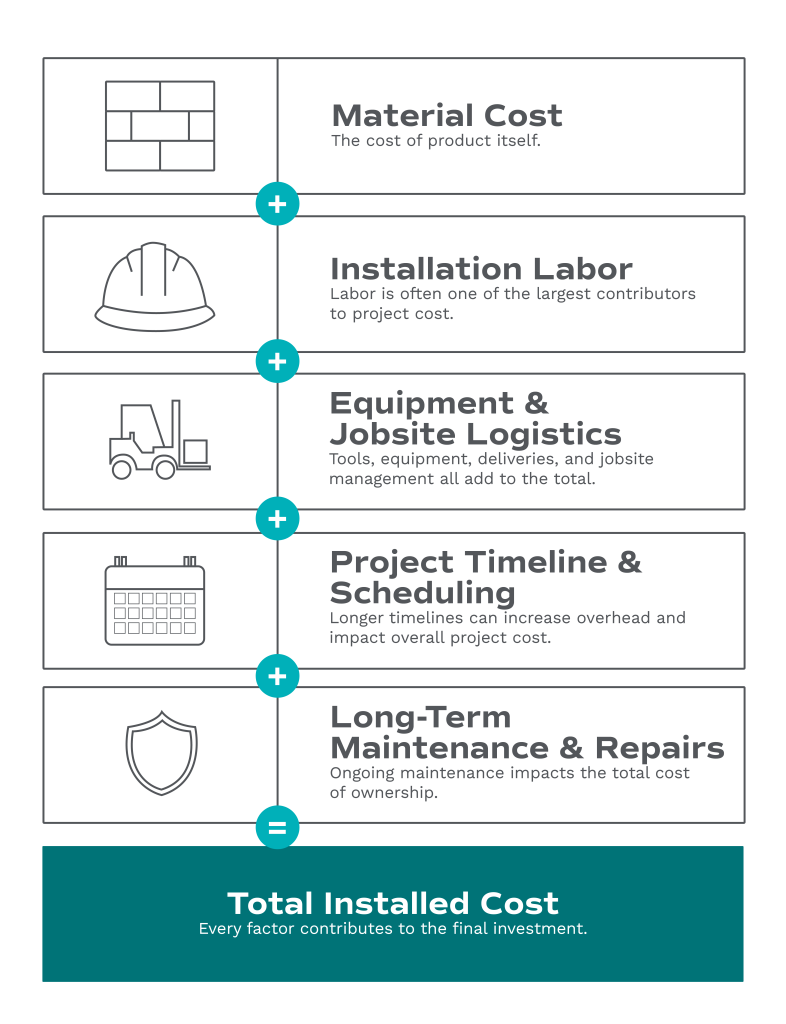
Considering each of these factors together provides a more comprehensive understanding of overall project value than comparing material prices alone.
The Bottom Line
Choosing an exterior cladding system is about much more than finding the lowest material price.
Today’s homeowners, builders, and contractors recognize that labor efficiency, project timelines, maintenance requirements, pricing stability, and long-term performance all contribute to a project’s overall value.
By combining mortarless installation, American manufacturing, stable factory pricing, and efficient installation, Evolve Stone offers an approach designed to help simplify construction while delivering lasting curb appeal.
When planning your next exterior project, don’t ask only:
“What does the material cost?”
Instead, ask:
“What will this project truly cost—from installation through long-term ownership?”
Looking beyond price per square foot and considering total installed value can lead to more informed decisions and greater confidence throughout the life of the project.
Learn More
Whether you’re planning a new home, remodeling an existing exterior, or specifying products for your next project, exploring installation methods, available stone profiles, and design options can help you choose the right solution for your goals.
To continue your research, explore:
Sources
- National Association of Home Builders (NAHB). Building Material Prices and Residential Construction Cost Trends.
- U.S. Bureau of Labor Statistics. Producer Price Index (PPI).
- U.S. Bureau of Labor Statistics. Occupational Outlook Handbook: Brickmasons, Blockmasons, Stonemasons, and Reinforcing Iron and Rebar Workers.